




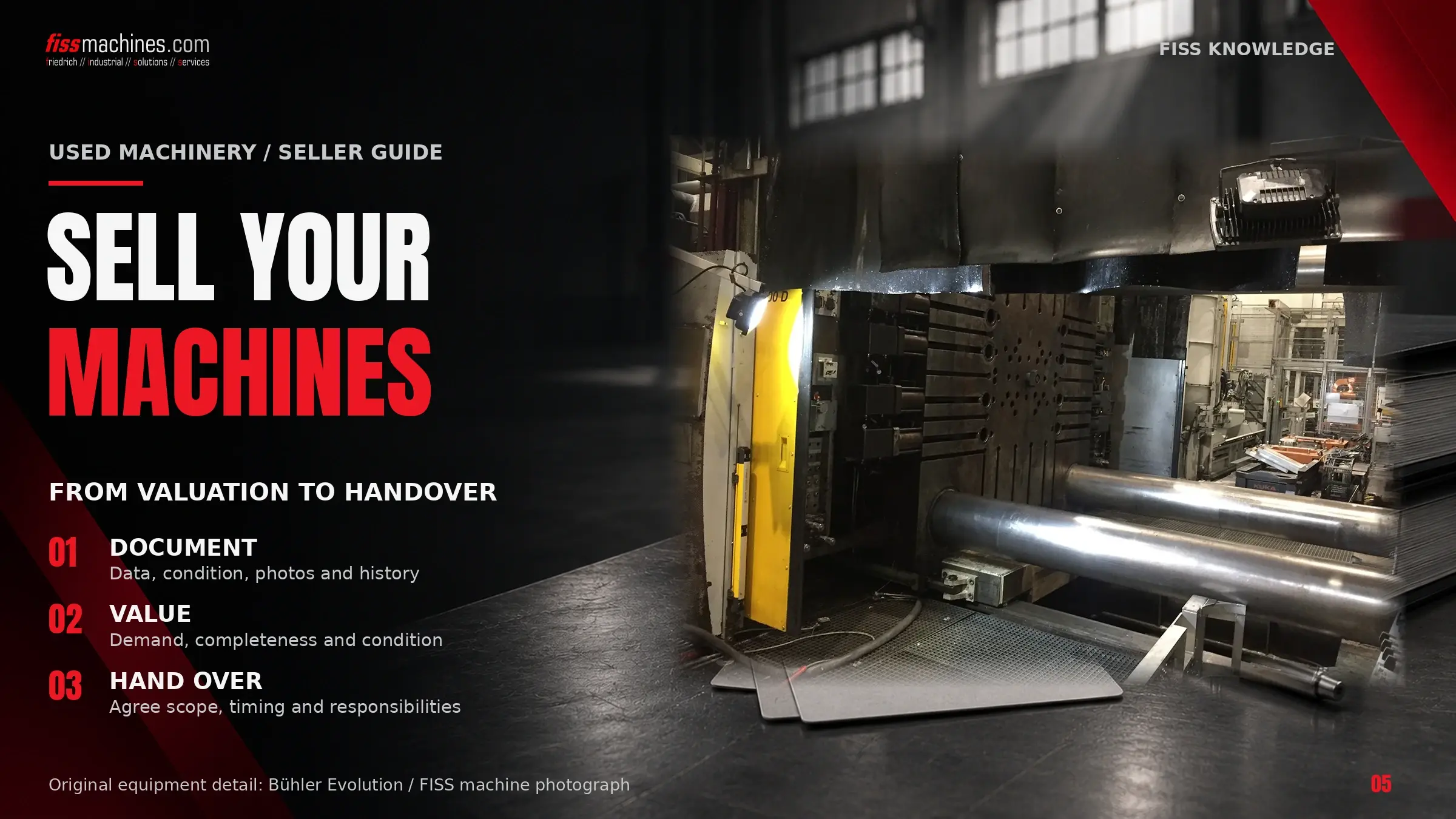
Selling Used Foundry Machines: Valuation, Sales Routes and Handover
Machines become available through new investment, product changes, site closures or the end of a leasing contract. Whoever wants to sell used foundry machines then has three questions: what is the machine realistically worth, which sales route fits – and how does it leave the hall safely, with the money secured?
What Matters When You Sell Used Foundry Machines?
The market sets the price, not the original purchase price. Buyers pay for demand for the machine type, condition and control generation, completeness and documentation – and deduct for uncertainty and for dismantling effort.
Sellers who document the machine while it runs, choose the sales route deliberately and put dismantling, loading and payment in writing sell faster and with fewer disputes.
What Drives the Value of a Used Machine
There is no generally valid formula for the value of a used die casting machine, furnace or press. A realistic valuation compares the machine with current demand for similar equipment. These factors decide how quickly it sells and at what level.
| Factor | Why Buyers Care | What the Seller Can Do |
|---|---|---|
| Machine type and demand | Common sizes and established makes find buyers more easily than special designs. | State exact model and main data. |
| Age and control generation | An obsolete control means spare-parts risk or a retrofit budget. | Name control type, software version and past upgrades. |
| Technical condition | Leaks, wear and recurring faults are priced in. | Disclose known defects openly. |
| Completeness | A cell with furnace, sprayer, extraction or robot is worth more than the bare machine. | Define which periphery and spare parts are included. |
| Documentation and history | Manuals, diagrams and maintenance records reduce the buyer’s risk. | Collect documents early. |
| Running or stored | A machine seen in production is easier to assess than one stored for years. | Document before shutdown; store dry. |
| Location and dismantling effort | Access, crane capacity, pits and media lines affect the buyer’s total cost. | Describe access and installation situation. |
An overhaul just before sale is not automatically worthwhile; many buyers prefer to define the scope themselves. See Overhaul or Retrofit?
The Information a Buyer Needs
Buyers check along the lines of our technical checklist for buying a used die casting machine. Every question answered in advance shortens the negotiation.
- Manufacturer, model, serial number, year of manufacture – photo of the type plate
- Main technical data, e.g. clamping force, shot data, tie-bar spacing, furnace capacity
- Shot counter or operating hours, photographed with date
- Hydraulic and electrical diagrams, operating manual, parts lists, foundation plan
- Maintenance and pressure-equipment inspection records, known faults
- EC declaration of conformity, if available (see CE marking and safety)
- Photos of all assemblies and videos of a complete cycle in production
Five Ways to Sell – Advantages and Limitations
| Route | Advantages | Limitations |
|---|---|---|
| Direct sale to a dealer | One contract partner, fast decision, no buyer search. | The dealer carries the resale risk, which is reflected in the offer. |
| Brokerage or consignment | Offered to end users; can achieve more if a matching buyer exists. | Takes longer; commission and terms must be agreed. |
| Auction | Fixed date, suits many items, open competition. | Result depends on bidders on the day; fees apply. |
| Own sale | No intermediary costs. | Enquiries, inspections, contracts, export checks and payment security lie with the seller. |
| Complete plant liquidation | Whole departments or sites cleared in one project. | Inventory, buyers, dismantling and site handover must be coordinated. |
The right route depends on deadline, number of machines and the seller’s capacity. FISS usually purchases used machines directly and, depending on the project, can also arrange buyers or take over international marketing – in suitable projects on a commission or success-fee basis. For leasing returns, insolvencies and plant closures see liquidation and machine recovery.
A Typical Sequence from Enquiry to Collection
Collect Data
Data, documents, photos, videos; clarify ownership and security rights such as leasing or bank financing.
Valuation and Offer
Assessment of the information, if needed with on-site inspection.
Contract
Price, scope, condition, delivery terms, dates, payment terms.
Payment
Payment or payment security before the machine leaves the site.
Decommissioning and Dismantling
Safe shutdown, draining, transport units, packaging.
Loading and Handover
Loading, handover protocol, documents, site clearance.
Duration is set mainly by fixed dates: last production day, buyer inspection, crane and rigger availability and, for closures or leasing returns, the date by which the hall must be clear.
Who Dismantles and Loads? Define It in the Contract
Many disputes start with unclear loading. According to the ICC, under EXW loading onto the buyer’s vehicle is at the buyer’s expense and risk, and the buyer handles export formalities. Under FCA at the seller’s premises, the seller loads and completes export clearance.
- Who disconnects electrics, hydraulics, water, air and gas – with qualified staff
- Who drains fluids, empties furnaces and disposes of residues
- Who provides crane, rigging and packaging, and who bears the risk
- What happens to foundations, pits and anchor bolts
- Transfer of risk, insurance, site access and working times
The technical sequence is covered in Relocating a Die Casting Machine; FISS also offers dismantling as a service.
Safe Decommissioning: Energies, Accumulators, Fluids
Isolate and Secure
Power, hydraulics, compressed air and gas are isolated and secured against restart; EN ISO 14118 covers isolation and energy dissipation.
Stored Pressure
Accumulators can hold pressure after the pumps stop. Depressurise the fluid side per manufacturer instructions before opening lines.
Drain and Dispose
Hydraulic fluid, coolant and release agent residues go to licensed disposal companies; waste oils fall under waste law.
Metal and Heat
Furnaces and dosing systems are emptied and cooled; lining and residues are assessed before transport.
Export, Sanctions and VAT – Check Before Signing
Many used foundry machines go abroad. Check buyer, destination and end use against EU sanctions and export control rules before signing. Regulation (EU) 2021/821 governs dual-use items; the Russia sanctions under Regulation (EU) No 833/2014 contain extensive export bans and, for certain goods, require a contractual “no re-export to Russia” clause. In Germany, the competent authority is BAFA.
An intra-EU supply to a business customer can be VAT-exempt if conditions are met, including the customer’s valid VAT number from another member state, proof of transport there and correct recapitulative statements. Exports outside the EU require proof of exit. This is general information, not tax advice – consult your tax advisor.
Handover and Payment Security
- Release the machine only after payment or reliable security, e.g. bank guarantee or letter of credit
- Retention of title if the machine leaves before full payment
- Confirm bank details by phone on a known number – fake payment instructions are a common fraud
- Handover protocol with counter reading, photos, included items and documents
- Leased or financed machines: written release by owner or lender before the sale
When FISS buys directly, FISS is the seller’s contractual partner, handles payment processing and, on request, inspection, dismantling, loading, transport and customs formalities.
Preparation Decides the Result
A used foundry machine sells best when buyers can assess it without guesswork: complete data, videos from production and honest condition information. Choose the route by deadline and effort, assign dismantling in writing, decommission safely, check export rules and release the machine only against secured payment.
Questions About Selling Used Foundry Machines
How Is the Value of a Used Die Casting Machine Determined?
By comparison with current demand for the machine type, considering age, control, condition, completeness, documentation and dismantling effort. List prices or depreciation formulas do not reflect the market.
Should the Machine Still Be Running When I Offer It?
Ideally yes. A machine shown or filmed in production is easier to assess and usually sells faster.
Can a Leased Machine Be Sold?
Only with the owner’s consent, usually the leasing company. Clarify ownership and security rights first.
Who Handles Export Formalities?
That depends on the delivery terms: under EXW the buyer, under FCA the seller. Sanctions checks remain relevant for the seller in any case.
Sell Your Used Machine to FISS.
Send FISS manufacturer, model, year, technical data, condition, location and photos or videos. FISS assesses the market value and discusses direct purchase or marketing through its network.
Sources
FISS Machines: Sell Used Machines and Equipment to FISS (your-offer) and Liquidation & Machine Recovery, fiss-machines.com, accessed 5 November 2026.
ICC Academy: Incoterms® 2020: EXW or FCA? – loading and export formalities under EXW and FCA, accessed 5 November 2026.
Council Directive 2006/112/EC on the common system of value added tax, Article 138, as amended by Council Directive (EU) 2018/1910 (“quick fixes”, applicable since 1 January 2020).
Council Regulation (EU) No 833/2014 concerning restrictive measures in view of Russia’s actions destabilising the situation in Ukraine, Article 12g; European Commission, FAQs on the “no re-export to Russia” clause, 2024.
Regulation (EU) 2021/821 setting up a Union regime for the control of exports, brokering, technical assistance, transit and transfer of dual-use items.
EN ISO 14118:2018 (identical to ISO 14118:2017) – Safety of machinery: prevention of unexpected start-up.
Directive 2008/98/EC on waste (Waste Framework Directive), Article 21 – waste oils.
